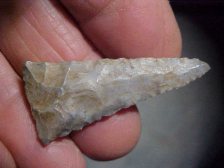
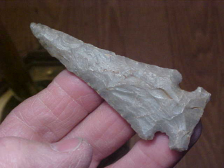
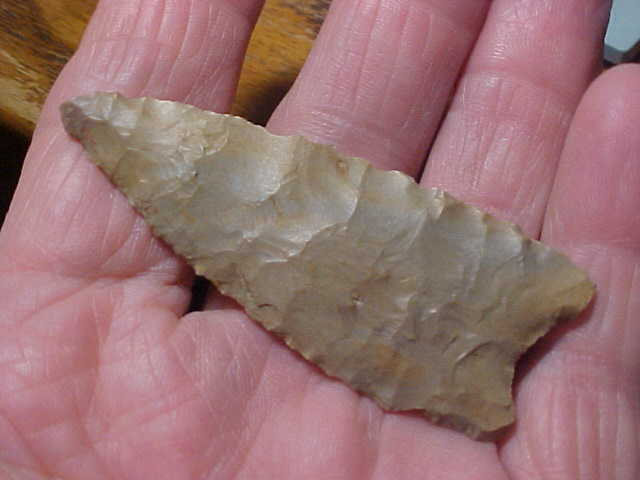
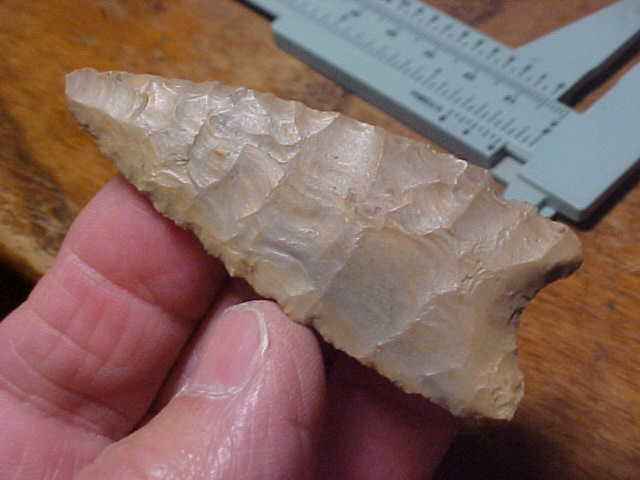
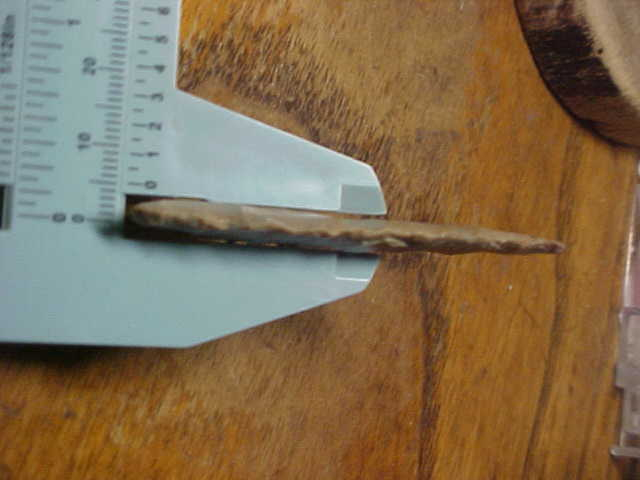
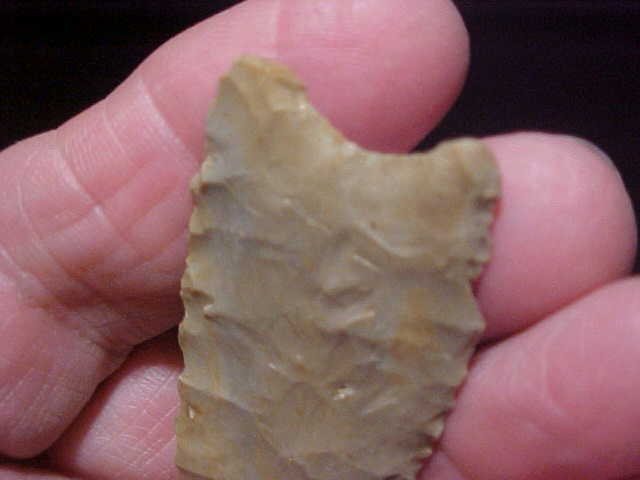
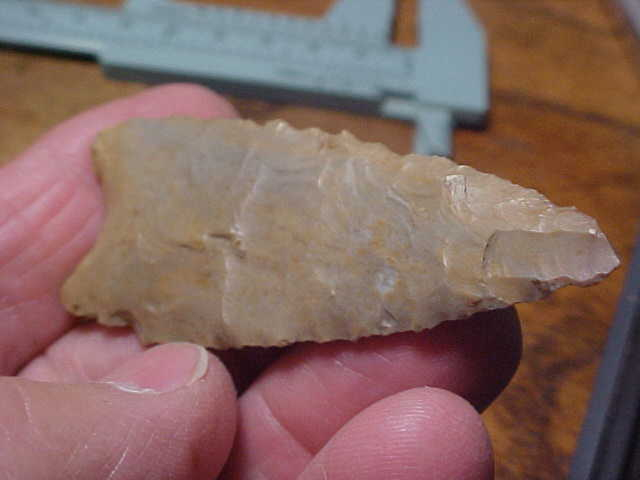
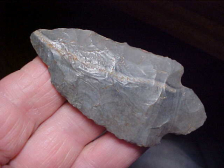
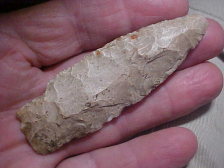
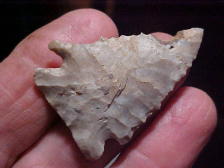
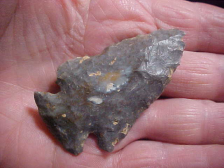
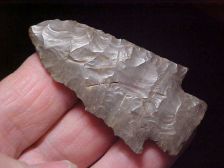
Supposedly from my S.W. corner of the Hoosier state, a strongly patinated (read that as VERY ancient) Indiana Harrison County-type Hornstone--2&11/16" by 1&1/16", yet only 3/16" max thickness. I've looked at the piece for a year-and-a-half now, I'm no closer to classifying the piece than the first day I saw it--fresh from a local auction where a long time friend bought several pieces. I bought the piece not only because it was 'local', but because I couldn't slap on a point type name--you learn from studying "the hard ones". Okay, first thing to be mentioned, there is NO basal or lateral edge grinding, not a bit. The patina is there, the hornstone clearly aged in what I recognize as "Early Archaic patina"--so, I have no doubt the point/ knife is in the 7500BP era. There are 'overshot' type long flakes that travel side-to-side--and the tip shows a use-made impact fracture; you know the tool was used--but by who??? The blade edge sharpening is an 'all four edges worked', not a bevel, so that lets out some of the more popular Early Archaic cultures. Note, too, that except for a 'smidgeon', we (here) were outside Dalton occupation range--some "stray hunter passing through" is about as close as I've come to who made the piece, but again, that lack of basal grinding and/or fluting, that eliminates some more possibilities. Anyone has some thoughts, I'd appreciate hearing them--you learn by listening. Best for an early Spring week, and if you're attending the upcoming March 22nd Boonville, Indiana, artifact show, stop by my table to say "Hi"--Roy A.
Disclaimer: Seller assumes all responsibility for this listing